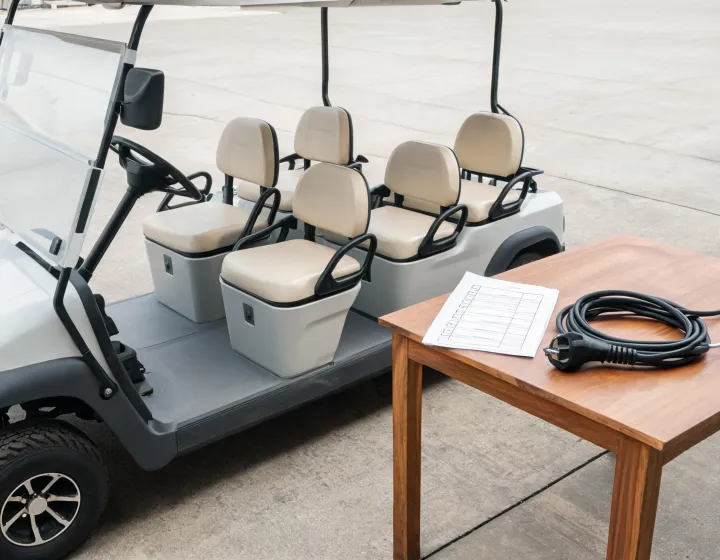
The most expensive mistake in six-seat cart planning is quoting the biggest number on the spec sheet and building a shift around it. The Club Car Onward 6 Passenger shows the trap clearly: the non-lifted version with HP lithium-ion extended range is listed at roughly 25–50 miles in its first year of use, the same cart on flooded lead-acid at about 15–35, a lifted lithium cart at 25–45, and a lifted lead-acid cart at 15–35. Schedule a full six-passenger loop against the 50 and you are planning on a best case, not a working average. A cart that runs dry mid-loop is downtime and a tow, not a rounding error.
The working figure is the bottom of the band for the exact configuration on order — 15 miles on flooded lead-acid, 25 on lithium extended range. Everything below is about why the top of that band is not a duty cycle. Every number here is tied to that one model and its stated battery and suspension variants; none of it is a category-wide specification for six-seat electric golf carts in general.
Why the Top Range Number Fails in Service
The spec page does not hide the split. Lower range estimates reflect maximum payload on moderate hills, and the higher estimates are based on driver-only operation on flat terrain. That is why the 15-to-35 band is not a tolerance around a single answer — it is two different working days for the same cart. Because the high end assumes one occupant and level ground, a six-passenger loop with gear aboard lands at the bottom of the identical range, which means the ceiling describes a best case and never a shift average. Quote the 50 in a scheduling meeting and that is the brochure talking, not the cart.
The failure mode is operational. Imagine this: a 35-mile cart becomes a tow job once it runs dry, with a lost round of service while someone fetches a recovery vehicle. Downtime plus a tow is a cost the battery step-up was meant to avoid.
What Range Actually Means on a Six-Seat Cart
On this model, range is the distance the cart covers from a full charge until the pack can no longer sustain the intended duty cycle, quoted for a stated battery type, suspension configuration, payload and terrain. The model name alone guarantees nothing; the battery and lift combination is what the figure attaches to.
Three quantities get confused with it. Stored energy capacity is how much work the pack holds — an input. Runtime is how long the cart runs at a given draw, measured in hours. Top speed is how fast it covers ground. Capacity divided by the draw gives runtime, and runtime multiplied by average speed gives distance, which means two carts with identical packs can post different range numbers because one carries more mass up more grade. Range is the output of that division, and it moves whenever either side of it moves.
Where the Miles Come From, Component by Component
Strip the marketing away and the arithmetic is simple. Usable pack energy, minus conversion and accessory losses, divided by tractive energy per unit distance, gives distance. The denominator is the interesting part: rolling resistance scales with total vehicle mass, grade force scales with mass times the sine of the slope, and aerodynamic drag scales with speed squared. Because a six-seater carries more seats, a longer frame and up to six bodies, its mass term is larger than a two-seat cart's, which means every gradient multiplies a penalty that flat-ground testing quietly hides.
The reason the manufacturer splits its estimates this way is that mass and grade dominate that denominator. Controller tuning and software settings move the number at the margins; it comes down to how much weight you move and how steep the ground is. A cart that behaves well on a dealer's flat lot can fall to the bottom of its own published band on a graded campus loop with nothing wrong with it.
Why the Lead-Acid to Lithium Gap Widens With Age
On the non-lifted cart, the year-one bands sit at 15–35 miles for flooded lead-acid and 25–50 for HP lithium-ion extended range. Club Car also states that Onward lithium-ion batteries retain significantly more usable capacity over time than flooded lead-acid options — an OEM claim rather than an independent test result, so treat it as a direction, not a measured curve.
Direction is enough to change a purchase. Because usable capacity fades faster on the lead-acid pack, the same shift consumes a larger share of what is left, which means the year-one gap understates the gap a fleet lives with as the pack ages. And because the published bands are explicitly first-year-of-use estimates, the aging effect sits outside them entirely, so neither number on the page accounts for it.
Five Inputs That Move Your Real Range
Payload and grade come first, because the manufacturer ties the low end of each band directly to maximum payload on moderate hills. Ambient temperature comes next: a cold pack slows the electrochemical reaction and raises internal resistance, which means less usable energy leaves the charger for the same nominal capacity. Tire pressure matters for the reason underinflation always has — it raises rolling resistance, and rolling resistance is a per-mile energy cost that runs the whole shift. Battery age can drop you below the first-year band the spec sheet quotes. Driving style shapes the draw side of the equation: repeated hard acceleration pulls high current that the pack delivers less efficiently than a steady cruise. None of these carries a multiplier here; the point is direction, and in the conditions described each one pushes the number down.
Check Tomorrow's Route Against the Low End
Suppose a campus or park loop of roughly eight miles per shift, run with a full six-passenger load over rolling grades on a non-lifted lithium extended-range cart. Take the low end of that configuration's band, 25 miles, rather than the 50-mile ceiling, hold back whatever reserve you are willing to run on, and compare what remains with the loop. Run the same arithmetic on the flooded lead-acid cart at 15 miles and see whether the cheaper pack still clears the shift with reserve intact.
No cart is being reported as tested here; this is arithmetic on published figures plus a stated assumption about the loop. What it settles is the purchase question. If an eight-mile loop clears 15 miles minus reserve, lead-acid is a defensible buy and the lithium premium has to justify itself on capacity retention instead of range. If it does not clear, the cheaper pack is not cheaper — it moves the cost to the tow and the missed shift.
What a Lift Kit Costs in Miles
The same page gives a clean before-and-after. Lithium extended range drops from a 25–50 mile band to 25–45 when the cart is lifted, while flooded lead-acid stays at 15–35 either way. The reason is physical: raising the chassis and fitting taller tires adds mass and rotational inertia and changes the frontal profile, all of which raise the per-mile energy on the denominator side. The loss lands at the top of the band, where a working cart rarely sits, which means lift looks range-neutral in a brochure and is not.
The trade-off only bites when the duty cycle already runs near the low end. A cart working well inside its low-end band can absorb a lift; one already near the low end cannot. That is a procurement conversation, not a specification one: ask for the low-end figure for the exact battery and suspension combination you are ordering, ask what duty cycle the estimate assumes, and ask how capacity retention is warranted across the service life you plan to run.
Today's move is one line on a route sheet. Pull the quote for the exact configuration on order — battery chemistry plus lifted or non-lifted — write its low-end range figure next to tomorrow's longest loop, and run that loop against the number instead of the ceiling. If it does not fit, get the configuration-specific estimate and the duty cycle behind it from the seller before you sign.

Leave a comment
Do not include confidential procurement data in a public comment. Use the inquiry form for sourcing requirements.