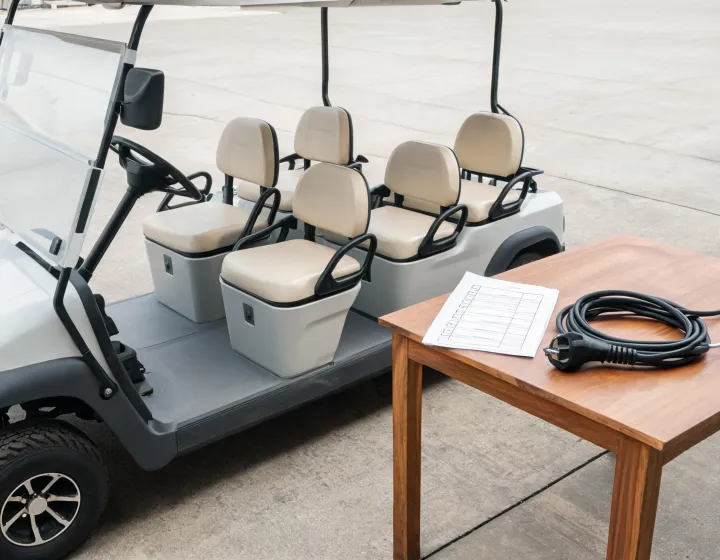
Picture a buyer two weeks before a fleet order goes out, standing in a covered storage bay with a tape measure against the door header while a Club Car Onward 6 Passenger sits half in and half out of the opening. In that imagined scene, the tape reads 78 inches. The cart in front of the buyer has a canopy on it. That single number decides the order.
The lift changes the footprint, not just the ride height. Club Car publishes 143 in (363.2 cm) overall length for the non-lifted Onward 6 Passenger against 148 in (375.9 cm) lifted, 48.8 in (123.8 cm) overall width against 51.3 in (130.5 cm), and 75 in (190.5 cm) topped height against 82 in (208.3 cm). Length grows by five inches. Width grows by 2.5 inches at the body. Canopy height grows by 7 inches. Those extra inches are enough to put the lifted cart outside a door, a trailer deck or an aisle that the non-lifted cart still clears.
Ground Clearance Gains 1.9 Inches
The number most people expect the lift to change is the one underneath, and it does. Club Car lists 4.5 in (11.4 cm) of ground clearance for the non-lifted Onward 6 Passenger and 6.4 in (16.2 cm) for the lifted version. That is a 1.9-inch gap.
That extra clearance earns its keep at transitions rather than on flat pavement: a curb cut into a maintenance yard, a gravel shoulder pushed up by plowing, the lip where a paved path meets a service road. On smooth asphalt the non-lifted cart has clearance to spare. On a route with repeated level changes, the lift stops being cosmetic.
The trap is treating clearance as proof of fit. It describes the space under the chassis and says nothing about the header above the canopy, the width of the gate you thread, or the length of the trailer deck. Buyers who solve for clearance first and measure everything else later tend to find the problem after delivery.
If your route is paved end to end and the cart sleeps indoors, skip the lift and keep the smaller footprint. If the route crosses rough ground daily, go lifted and accept that every other dimension in this comparison grows with it. The trade-off is one-directional: clearance goes up, and so does everything else.
Length Adds Five Inches With the Lift
Length is the dimension buyers forget, because a lift reads as a vertical change. On this model it is horizontal too. Overall length runs 143 in (363.2 cm) non-lifted and 148 in (375.9 cm) lifted. That is five inches more cart from bumper to bumper.
That extra length sounds trivial until you put it where six-seat carts actually live. A trailer deck sized around the shorter cart now needs the longer deck plus allowance front and rear for tie-downs. A garage bay that closed with room to spare now has you parking by feel. And a row of striped stalls in a maintenance building quietly loses capacity, because the lines were laid out around the shorter cart.
Suppose a fleet runs ten carts in a building with 145 inches of clear bay depth. In that hypothetical, the non-lifted Onward fits; the lifted version does not, and careful parking does not fix a wall.
Ramp behavior is not something you can read off a specification page. A longer cart changes how a ramp approach feels, but run the actual cart up the actual ramp before you commit.
If trailer deck length or bay depth is fixed and tight, go with the non-lifted cart and stop shopping. If you have slack in both, the extra length costs you nothing and the lifted version stays on the table.
Width and Front Track Both Grow
Width splits into two numbers here, and they do not move together. Overall width is 48.8 in (123.8 cm) non-lifted against 51.3 in (130.5 cm) lifted. That is 2.5 inches more at the body. Front wheel track is 37 in (94 cm) against 40 in (101 cm). That is three inches more at the front axle. Rear wheel track stays at 40 in (101 cm) either way.
That last figure is the useful one. Rear wheel track is unchanged between the two configurations, so the lift neither narrows nor widens the back of the cart. What grows is the body shell and the front stance. For a buyer threading a gate or parking between columns, body width decides whether you scrape a fender, while front track decides how much room the steered wheels need before the body even arrives.
Both numbers are small enough to ignore on open pavement and large enough to matter where these carts get used: service corridors behind a building, side yards between a fence and a wall, ramp decks with railings on both sides, the gap between parked equipment in a yard.
If your narrowest point is under the lifted body width, the lifted body is out and the conversation ends. If it lands between the two body widths, the non-lifted cart clears and the lifted one does not, which is an awkward place to be after paying for the upgrade. Measure the tightest point on the route at body height, not the widest point at ground level.
Canopy Height Is the Bigger Clearance Risk
Height is where this comparison usually ends, and it deserves its own numbers. Topped height with the canopy on is 75 in (190.5 cm) for the non-lifted cart and 82 in (208.3 cm) lifted. The topped gap is 7 inches. Untopped, with no canopy, it is 47.5 in (120.7 cm) against 54.5 in (138.47 cm). The untopped gap is also 7 inches. That tells you the lift raises the whole structure rather than only the roof.
The canopy figure is the one to carry into a building survey. Suppose the header measures 78 inches: it would clear the non-lifted cart and fail the lifted one, because 78 sits between the two published heights. Overhead door tracks, light fixtures hung below a slab, sprinkler piping, mezzanine edges, the low side of a sloped roof: all of these are checked against topped height, and all of them are easy to miss because they sit above eye level while you walk the site.
The untopped figure matters for a different reason. Carts stored or shipped without canopies need the untopped height rather than the canopy height, which changes rack heights and trailer stacking plans. Buyers who compare only canopy heights get caught when stripped carts arrive and the rack was built to a different number.
If anything on the route hangs below the lifted canopy height, skip the lifted canopy configuration rather than planning to duck through on delivery day. If your clearance is generous but your storage racks are fixed, check the untopped height against the rack before ordering either version.
Wheelbase and Wheel Packages Change Together
Wheelbase barely moves: 102 in (259.0 cm) non-lifted, 103 in (261.6 cm) lifted. One inch over a footprint this long is not a handling story and should not be sold as one. The wheel and tire package does move: Club Car lists 10 in (25.4 cm) and 12 in (30.48 cm) wheel and tire options on the non-lifted Onward 6 Passenger, and 14 in (35.56 cm) on the lifted version.
Read those together and a common misreading falls apart. The lift is not a tire swap with a spacer bolted on. The smallest wheel offered on the lifted cart is two inches larger in diameter than the largest wheel offered on the non-lifted cart, and suspension is a separate line in the specification. A buyer who assumes the lifted wheel package can be added to a non-lifted cart and produce lifted dimensions is comparing a parts list to a configuration.
For fleet planning, the practical effect is that the lifted cart's stance is set by a package you cannot mix and match. If you are matching new carts to an existing fleet of non-lifted units, the wheel difference alone shows up in spare wheel inventory and service planning.
If you already stock the smaller non-lifted wheel sizes, adding lifted carts means a second parts line. If your fleet is new and you can standardize on one package, settle the lift question first, because the wheel decision follows it and not the reverse.
Curb Weight Table Needs a Second Look
The published weight table for the Onward 6 Passenger lists six curb weights: 980 lb (444.5 kg), 1,101 lb (499.4 kg), 1,293 lb (586.5 kg), 1,429 lb (648.2 kg), 1,005 lb and 1,141 lb (518 kg), with vehicle load capacity at 1,200 lb (544.3 kg) across the row.
What the table does not do, in the form it is published, is tie each curb weight to a named combination of battery pack and suspension. Six numbers, six capacity figures, and columns that do not let you say the lift adds exactly this many pounds. Anyone quoting a single lift weight penalty from that table is guessing which column belongs to which build.
Two readings are safe. The spread between the lightest and heaviest published curb weight is 449 lb, large enough to matter for trailer sizing, tie-down planning, floor loading in an upstairs storage area and how much margin you have left against a trailer's rated capacity. Payload does not scale with curb weight in this table: the same load capacity appears for every column, so a heavier build starts closer to its limit with the same six passengers and cargo aboard.
If you are ordering for a site with a floor load limit or a trailer with fixed capacity, ask for the exact configuration sheet with suspension, battery, wheel and tire package and canopy called out, and get the curb weight for that build. If you are budgeting roughly, use the heaviest published figure as your planning number and treat anything lighter as margin.
Which Version Fits Your Daily Route
Put the numbers against a route and the gaps collapse into a short set of gates. The gaps are modest on paper; the gates are what decide the order.
If the header on your storage bay is lower than the lifted canopy height, the lifted canopy configuration is out, and you go with the non-lifted cart. If the trailer deck is shorter than the lifted overall length, the lifted cart is out on length alone. If the narrowest gate or aisle on the route is tighter than the lifted body width, the lifted body is out. Each of those is a hard stop rather than a preference, and any single one removes the choice.
If none of them trip and the route genuinely calls for the extra ground clearance, go lifted and accept the larger footprint as the price of the ground clearance. That is the trade-off in one line: fit traded for clearance, where the fit constraints are the ones that bite after delivery.
Groups sort themselves along the same lines. A fleet running paved routes between buildings, trailers and marked stalls should default to the non-lifted cart, because every dimension that touches shared infrastructure is smaller. A private owner with a rough yard and a wide driveway can justify the lift, provided the measurements pass first.
There is a mixed case worth naming: a site that needs clearance on part of the route and has tight openings elsewhere. No single configuration solves that. Either the route gets changed or the fleet splits into two configurations, and splitting means two sets of dimensions, two parts lines and two sets of assumptions to keep straight.
What to Measure Before You Sign
The measurements that matter before an order goes in are physical and cheap to take. Door clear height at the lowest obstruction rather than at the frame. Opening width at the tightest point. Trailer deck length, usable, from the front stop to the rear edge. Aisle width at the narrowest pinch. Turning space where the route changes direction. Rack height if canopies come off. Bring a tape measure, not a brochure.
Then match those numbers to the configuration you are actually buying, not to the model family in general. Ask for the sheet covering suspension, wheel and tire package, canopy and battery, with the curb weight for that build. The six-column weight table is a planning starting point, not an answer to which cart you get.
One boundary belongs on the page. Everything here describes the Club Car Onward 6 Passenger as published by Club Car for the US market, with lifted and non-lifted variants listed separately. A different six-seat cart, a different model year or an aftermarket lift kit carries its own numbers, and none of these figures transfer. Use this model as a worked example of which dimensions to check and in what order.
Back in the imagined bay, the tape settles it: the canopy will not clear the header, so the lifted configuration is out no matter how much clearance sits under the chassis. The order goes out for the non-lifted Onward 6 Passenger, and the buyer writes the door measurement into the fleet file so the next cart order starts from the site, not the spec sheet.

Leave a comment
Do not include confidential procurement data in a public comment. Use the inquiry form for sourcing requirements.