-
What Number Caps Load on This Six-Seater?
-
Why a Heavier Battery Doesn't Lower the 1,200-Pound Rating
-
GVWR, Curb Weight, and Load Capacity Are Not the Same
-
How Many Real Adults Fit Under 1,200 Pounds?
-
What Full Payload Costs You in Range and Hills
-
Where Does Cargo Go on a Six-Seat Layout?
-
What to Ask Before You Order One
On the Club Car Onward 6 Passenger, the figure that caps people plus cargo is 1,200 lb (544.3 kg) of vehicle load capacity, and it reads the same on all six variants in the published specification table. That is a manufacturer number for one named model, not a rule for every six-seater electric golf cart on the market, and it counts the passengers as part of the load.
So why does the cart's own weight swing by hundreds of pounds across those variants while the load figure sits perfectly still?
What Number Caps Load on This Six-Seater?
Vehicle load capacity is the allowance a manufacturer publishes for everything the cart carries beyond itself: the driver, the passengers, the bags in the back, the tools under the seat. On this model it is 1,200 lb (544.3 kg), and the specification table repeats that figure for all six battery and lifted or non-lifted variants without variation.
Seating capacity sits in the next column, listed as 6 six times over. The two numbers are not derived from each other, which is where a lot of buying decisions go sideways. Total (Curb) Weight in the same table runs from 980 lb (444.5 kg) on the lightest build to 1,429 lb (648.2 kg) on the heaviest, and those are figures for the cart with standard equipment and fluids before anyone climbs aboard. Which raises the question that decides whether this layout works on your route: what happens to the 1,200 lb once the vehicle itself has gained several hundred pounds?
Why a Heavier Battery Doesn't Lower the 1,200-Pound Rating
Nothing in the published rating changes. The curb weight column moves across the six variants. The load capacity column does not. Why would one column shift by hundreds of pounds while the other stays bolted down?
Because the two columns answer different questions. Curb weight describes the vehicle as configured. Load capacity describes an allowance the manufacturer attaches to the model line, and it holds at 1,200 lb whether the cart rolls out at 980 lb (444.5 kg) or at 1,429 lb (648.2 kg).
Two numbers, one flat. Whatever the build weighs, the allowance printed beside it stays where it is.
What the page does not publish is a gross vehicle weight rating for each individual variant. Without that per-variant figure, nobody reading the same table can work out how much margin the heaviest build has left against its own rated maximum. Ask the seller for the GVWR on the exact configuration you are quoting; the gap between that number and the curb weight as built is what remains for people and cargo.
GVWR, Curb Weight, and Load Capacity Are Not the Same
Three weight terms get used interchangeably in showroom conversation, and each answers a different question. Gross vehicle weight rating is the value a manufacturer specifies as the loaded weight of a single vehicle, which makes it a ceiling on the whole vehicle rather than a cargo figure. Curb weight is the weight of the vehicle with standard equipment, maximum engine fuel, oil and coolant, plus air conditioning and any optional engine weight where fitted. Load capacity is the allowance published for what you put on board.
Which of the three governs your loading? The payload allowance does. GVWR caps the cart including itself. Curb weight caps nothing at all, it only eats into the other two. When a seller quotes a curb weight and calls it payload, the conversation has already gone wrong.
One boundary worth holding onto: those federal definitions describe the vehicle classes and services covered by the regulation they come from. Whether a particular cart gets registered as a motor vehicle, and whether your state or municipality permits it on a road, is a separate question that no specification sheet settles.
How Many Real Adults Fit Under 1,200 Pounds?
Designated seating capacity is a count of designated seating positions, nothing more. Six positions means the cart is built with six places to sit, and the definition stops there. It says nothing about how much those six people may weigh.
So run the arithmetic on three ordinary assumptions. Suppose six adults averaging 150 lb each: 900 lb of people, leaving roughly 300 lb for everything else on board. Suppose the average is 190 lb: 1,140 lb of people, leaving about 60 lb, one small cooler and very little more. Suppose the average is 230 lb: 1,380 lb of people, already past the 1,200 lb (544.3 kg) allowance with the cart standing still and no cargo loaded.
Those body weights are illustrations, not measurements from any fleet, and your own riders may sit well above or below them. The structure of the problem does not change: at ordinary adult weights, six full seats consume most or all of the published allowance, and the luggage you pictured riding along has nowhere to come from.
What Full Payload Costs You in Range and Hills
The manufacturer splits its range estimates by load. The lower figures reflect maximum payload on moderate hills; the higher figures assume driver-only operation on flat terrain. Same model, two very different duty cycles.
Read that note as a statement about energy, not about structure. Nothing in it alters the 1,200 lb allowance, and staying under the rating does not make a loaded cart behave like an empty one. So what does a full load cost you on a real route? A six-seater running at capacity on grades works harder and covers fewer miles per charge than the same cart with one person aboard.
If your route has hills and your seats are usually occupied, plan the day around the low end of the published spread. Treat the high number as the figure for a driver on flat pavement, because that is the condition the manufacturer names.
Where Does Cargo Go on a Six-Seat Layout?
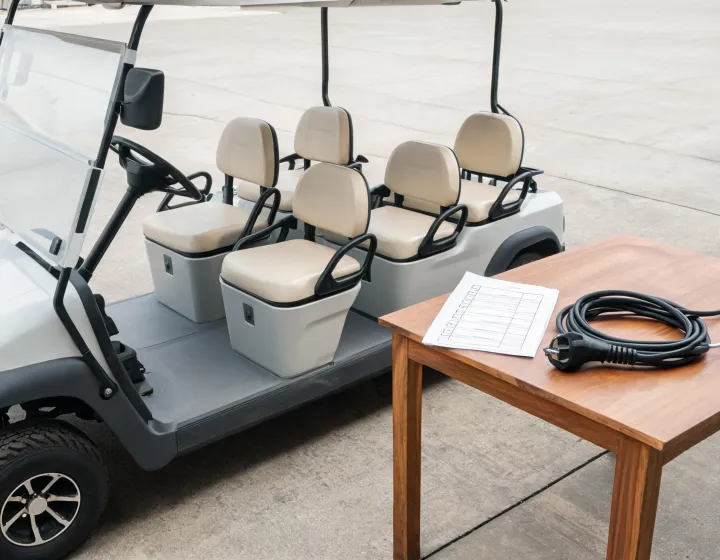
The layout explains the squeeze. Two rows face forward and a rear-facing bench sits in the back, with grab handles and dual cup holders in the second row and a long one-piece canopy shading the rear-facing passengers. That bench occupies the tail of the cart, which on a utility build would be the cargo bed.
Cargo and the third row are therefore not two separate budgets. They draw on the same 1,200 lb (544.3 kg) allowance, and every pound sitting on that rear bench is a pound unavailable for a bag, a toolbox or a case of water. The seats do not add capacity, they spend it.
On a shuttle run where the rear bench fills for ten minutes at a time, that trade costs you nothing. On a service route where the rear bench is occupied all day and parts still need to move, it costs you the cargo room you assumed came with the purchase.
What to Ask Before You Order One
Get answers in writing rather than from a brochure. Ask for the gross vehicle weight rating printed on the vehicle you are actually quoting, not the rating for the model family. Ask whether the quoted curb weight already includes the accessories on your build, since a lift kit or an extra battery pack adds mass. Then ask what payload remains once those accessories are fitted, and how your daily route, meaning the grades and the distance between charges, maps onto the low end of the published range estimate.
Why bother with all four: the vehicle's own weight spans 449 lb across the variants in a single table while the load allowance stays fixed at 1,200 lb. Variant choice moves your real margin without ever touching the headline number.
This layout is not for the operator who needs six adults and boxed cargo on the same trip, because the rear bench and the cargo floor occupy the same real estate and share one allowance. It is for sites where the seats fill intermittently and loads stay light: lobby shuttles, property inspections, guest moves across a resort or campus, where six seats are peak capacity rather than the daily norm.

Leave a comment
Do not include confidential procurement data in a public comment. Use the inquiry form for sourcing requirements.