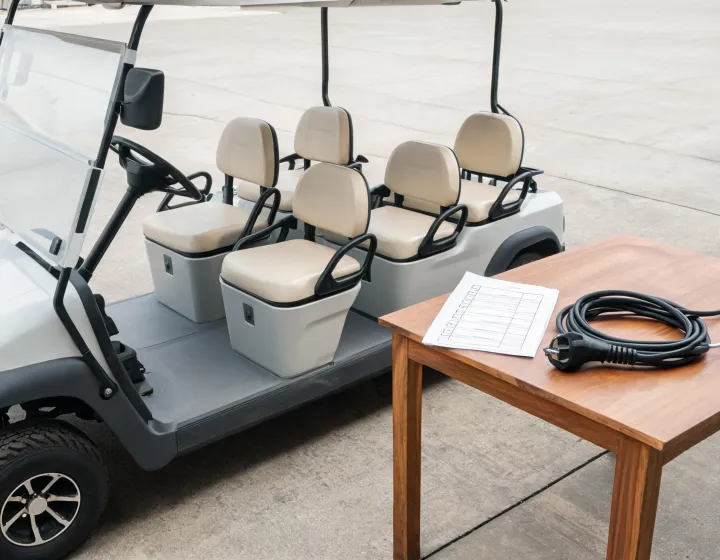
Does a lithium six-seater really need less maintenance, or just a different maintenance routine? On the Club Car Onward 6 Passenger, the lithium pack is documented as a no-watering, no-terminal-maintenance routine, so one whole category of work comes off the schedule and does not come back.
Stay inside that one model for the rest of this piece. The figures below are Club Car's published specifications for the Onward 6 Passenger in both lifted and non-lifted suspension, and they are manufacturer statements, not independent test results. A range number that belongs to this cart does not automatically describe the six-seater on the next property, and I will not stretch it that way.
What Stops Being a Chore on the Lithium Pack
The work that disappears is narrow and specific. Club Car's specification page for this model says there is no watering, cleaning or terminal maintenance required — the fluid-and-terminal routine that quietly eats a maintenance tech's morning and gets skipped the first week the property is short-staffed.
The same page goes further, describing the Onward HP lithium-ion pack as offering longer life, zero maintenance, faster charging and enhanced safety compared with flooded lead-acid. Read those as manufacturer claims written in the same breath as the maintenance line: no independent lab work is attached to them, and the word zero is carrying a lot of weight.
What does not disappear is anything with a plug on it. The lithium cart still gets charged, the charger still gets looked after, and the cart still wants the general care any six-seat vehicle wants. A buyer who reads zero maintenance as nothing to do is over-reading a sentence about water and terminals.
For a fleet, that is a staffing question rather than a comfort one. Where nobody on site owns a watering route, the flooded cart's routine does not vanish; it just goes undone. What an undone watering routine does to a flooded pack over a season is worth asking the seller directly, because the page only describes the routine being kept up.
Forty Percent Faster Charging, and What It Buys
Club Car lists lithium-ion charging as up to 40% faster than lead-acid on this model, framed as reduced downtime and a quicker return to the road. Two words carry the weight: up to, and the baseline the page never publishes. Faster than what charge time, on which charger, starting from what state of charge — the specification does not say, so the 40% is a relative turnaround claim rather than a number of minutes you can pencil into a shift plan.
Your duty cycle decides whether that percentage is worth anything. Suppose a resort runs one six-seater on a morning guest loop and again after lunch, with a two-hour window in between when the cart sits at the maintenance barn — a hypothetical, not a published case. If the flooded cart needs most of that window to come back and the lithium pack finishes with time to spare, the faster charge converts into a full second loop. If your cart goes on the charger at closing and comes off at opening, the same 40% buys nothing you can put on a schedule.
Charging speed becomes a real feature only where the cart is the bottleneck. Across a fleet rotating through shifts, it usually is; on a property with one cart and an overnight window, it usually is not.
Reading the 15–35 and 25–50 Mile Range Bands
First-year range estimates for this model split by battery and by suspension, and the split rewards close reading: non-lifted flooded lead-acid at roughly 15–35 miles, non-lifted HP lithium-ion extended range at roughly 25–50, lifted flooded at roughly 15–35, lifted lithium at roughly 25–45. The page also states what produces each end, with the low estimates reflecting maximum payload on moderate hills and the high ones based on driver-only operation on flat terrain.
That condition sentence is the most useful line on the page for a six-seater. A six-passenger cart's job is carrying six people, which puts its realistic position near the bottom of whichever band it sits in rather than the middle. The 35-mile flooded figure and the 50-mile lithium figure both assume one person aboard on level ground, conditions a working six-seater rarely meets.
Plan with the band width, not the midpoint. The top of each band is a driver-only, flat-ground number, so the honest planning figure for a working cart is the bottom of its band — which is why the distance between 15 and 25 matters more than the distance between 35 and 50.
Which Battery Fits Your Route and Your Crew
Take the short, flat, driver-only loop first: a clubhouse-to-parking shuttle, a two-block property run, a cart that mostly moves one person and a toolbox. Go with the flooded lead-acid cart there. Its 15–35 mile band covers the loop, and lithium's headroom is capacity you would pay for and never spend.
Now put a full crew on grades. If the cart routinely leaves with six aboard and climbs, go with the HP lithium extended range, because the flooded cart's band bottoms out at 15 miles, and full payload on hills is precisely the condition that produces that low end. That is not a comfort upgrade; it is the difference between finishing the afternoon loop and parking the cart early.
On a lifted cart, skip the assumption that lithium range carries over unchanged from the non-lifted version. The published lifted figure tops out at 45 miles against 50 for the non-lifted cart, so the lift trims its own headroom before terrain gets a say.
The trade-off runs in both directions: lithium buys range headroom you may never spend on a flat, short route, and flooded keeps a lower ceiling that never gets tested on that same route. Where one property runs mixed duties, split the order by duty rather than by budget, with the fast-turnaround cart on lithium and the all-day low-speed unit on flooded.
Year Four Capacity at 35 vs 90 Percent
Club Car publishes a four-year comparison for this model: after approximately four years of use, flooded lead-acid retains about 35% of original capacity while lithium-ion retains about 90%. Same page, same cart, and no asterisk separating the two numbers.
Run the published first-year bands through those percentages and the shape of year four appears — arithmetic on the manufacturer's figures, not measurement. At 90% of original capacity, the bottom of the non-lifted lithium band works out to about 22.5 miles instead of 25. At 35%, the bottom of the flooded band works out to just over 5 miles instead of 15. Same chassis, same route, four years later.
That bottom-of-band figure is the number that matters. It is not a cart doing slightly less work; it is a cart that has stopped covering the loop, while the lithium cart at 90% still sits near the band it started with. Which is why the maintenance question and the replacement question turn out to be one question asked twice.
Hold the limits in view. These are manufacturer figures for one named model, built on a first-year range basis, with no independent testing behind them. Treat the percentages as planning arithmetic for when to schedule replacement, not as a promise about any particular cart's fourth summer.
The Trade-Off Nobody Puts on the Spec Sheet
Two things to nail down before the quote is signed. Confirm which battery and which suspension configuration the quoted cart actually is, because the same page lists 25–50 miles non-lifted and 25–45 lifted for lithium. Get the configuration written on the quote instead of implied by a photo.
Then ask what the 40% faster charging figure is quoted against: which charger ships with the cart, and what baseline charge time the percentage is measured from. The page states no baseline, and a percentage without one is a relative claim you are accepting on faith.
Here is where I land as a buyer. On a property where nobody is assigned to a watering route, I would order the lithium cart and stop haggling over the upfront difference, because the year-four capacity gap is the part that changes the decision. That holds while the cart stays with you past year two and runs daily; on a one-season cart you plan to flip, the case weakens fast and the flooded unit is easier to justify.
That is the honest boundary. Price, warranty terms and how comfortable your local shop is with each pack are all real parts of this purchase, and none of them are on the page I have been reading. Ask the seller those directly.
Choosing lithium on the Onward 6 Passenger buys a maintenance routine that fits a crew with no spare hands, and a pack that still holds most of its capacity in year four. It costs the lower upfront sticker and the servicing habit your local shop may already have down to muscle memory — which is the whole trade, and the only part of it you actually have to decide.

Leave a comment
Do not include confidential procurement data in a public comment. Use the inquiry form for sourcing requirements.