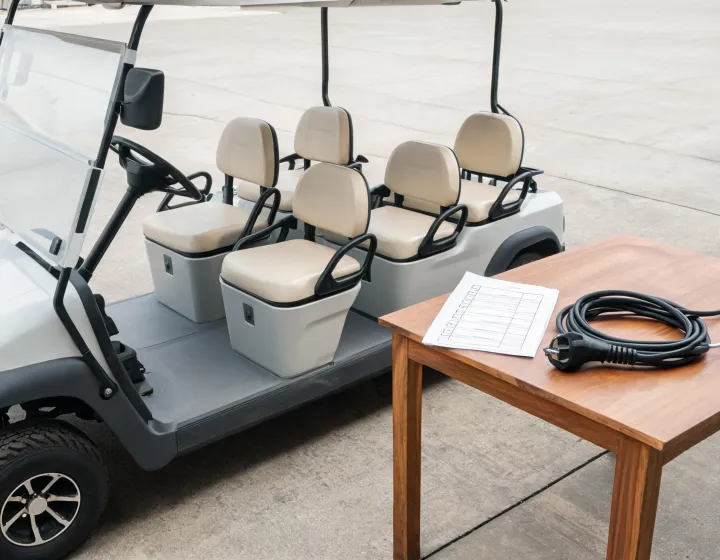
Nineteen miles per hour is the number that settles the paperwork on a six-seat cart. Club Car rates the Onward 6 Passenger at a top speed of up to 19 mph (30 kph) and classifies it as a Personal Transportation Vehicle, and that figure — not the three rows of seats — is what decides which rulebook the vehicle sits in. The federal speed criterion for a low-speed vehicle starts above 20 mph. This cart tops out at 19.
Everything below is about that named configuration on a US specification page, with battery and lifted versus non-lifted variants treated as distinct builds, because the classification answer is configuration-specific and does not carry across a category. What separates a six-seater golf cart from a six-seat LSV comes down to three written facts: four wheels, an attainable speed inside a narrow band, and a gross vehicle weight under a fixed ceiling. Seat count appears in none of them.
The 19 MPH Number That Decides the Label
The federal definition of a low-speed vehicle is a three-part test. The vehicle has four wheels; its speed attainable in 1.6 km (1 mile) is more than 32 km/h (20 mph) and not more than 40 km/h (25 mph) on a paved level surface; and its GVWR is less than 1,361 kg (3,000 lb). Wheel count is settled by the build. The weight figure has to be checked against the exact configuration. Speed is where this cart already answers for itself.
Nineteen is not more than twenty, so the Onward 6 Passenger sits outside the speed criterion as rated — which is why the manufacturer's own page files it as a PTV rather than an LSV. What moves that number is not the seating chart but the attainable speed the builder certifies for the build; a third row changes mass and layout, not the rated envelope.
The band is closed at both ends, and that surprises people who only remember the top limit. A build that cannot reach 20 mph falls outside the class on the low side, and a build that runs past 25 mph falls outside it on the high side. A six-seat cart has to land inside that band to wear the LSV label at all.
Where Golf Cart Ends and LSV Begins
Golf cart is a use word. The same three-row vehicle is described as approved for golf-course use in non-lifted form and as drivable in neighborhoods and planned communities where PTVs are locally permitted. Nothing in that description is federal. PTV is the manufacturer's filing plus whatever your town allows, and it reaches no further than that permission.
A second manufacturer shows how loosely the street word gets spent. The GEM e6 page sells a six-passenger electric shuttle on street-legal safety features, comfortable seating and doors for all six. That is an equipment claim, and equipment is not a class. Because the quoted page text carries no attainable speed figure and no exact GVWR for that build, it settles nothing about LSV status; the class question stays open until those two numbers are written down for the specific configuration.
So the three labels stack in order. Golf cart describes duty. PTV describes a manufacturer's filing plus local permission. LSV describes a federal motor-vehicle class with a numeric definition — and only the last one is a test a configuration can fail.
Why Weight, Not Seat Count, Sets the Ceiling
The weight criterion is written as a strict inequality: less than 3,000 lb. Strict means the boundary itself sits outside the class, and the reason that matters in the field is that a rounded marketing figure cannot answer a strict inequality. A page that prints 3,000 lb does not tell you which side of the line the build sits on.
Mass reasoning pushes the same direction. A third row is structure — a longer frame, more floor, more seat and belt anchorage — plus two more occupants and whatever they carry. All of it lands on one side of the scale, so a six-seat build starts with less headroom under a fixed ceiling than a two- or four-seat build on the same platform. Which means the deciding number has to be the exact GVWR stated for the configuration on your order, not the platform's figure and not the two-seat version's.
What the LSV Label Actually Buys You
Federal equipment rules exist for a stated purpose: low-speed vehicles operated on public streets, roads and highways are to be equipped with the minimum motor vehicle equipment appropriate for motor vehicle safety. Read the scope of that sentence carefully. That obligation is written for public pavement, not for a fairway.
The safety side of the trade is stated just as plainly. Commercially available electric vehicles must meet the Federal Motor Vehicle Safety Standards and undergo the same rigorous testing as conventional vehicles sold in the United States; low-speed electric vehicles, also called neighborhood electric vehicles, are the exception, held to less-stringent standards because they are typically limited to low-speed roadways as specified by state and local regulations.
Put those two together and the label stops being an abstraction. Because the equipment list exists only for a class allowed onto public pavement, an LSV classification is buying street access plus the kit that access requires, while a PTV classification rests on local permission instead of a federal equipment standard. Neither one settles the road question, since the federal definition says nothing about which streets your state or town opens to the class — that permission is granted somewhere else entirely.
Six Seats for Course Duty or Street Duty
Course approval for the Onward 6 Passenger is stated for the non-lifted model only. That is a configuration boundary, not a trim preference. A lifted six-seat build has no course approval stated, and a buyer who assumes otherwise is buying the badge instead of the document.
Duty cycle settles the rest. On a course the cart does not meet a pavement edge, so the LSV equipment package and the compliance work behind it buy nothing you can use — you pay for hardware and a certification that stays in a drawer. If the route crosses a public road, or runs on a community street where the locals permit PTVs, the label becomes the whole purchase and the equipment list is the point.
The call I would make on a quote: private-site and course operators should take the non-lifted PTV-spec six-seater and spend the difference on batteries and tires. Fleet and shuttle buyers whose route leaves private property should pay for the LSV-class vehicle instead. That preference reverses the moment one of three conditions holds — the route crosses public pavement, your local authority does not permit PTVs on the streets you need, or the build is lifted and the stated course approval no longer applies.
The One Document to Request Before You Sign
One ask, before signature: the compliance and label paperwork for that exact configuration, showing the certified top speed and the GVWR the builder states for it, plus written confirmation from your state or local authority that the intended route permits the class.
Why this and not seats or price. The classification question and the road question are answered by two different authorities, so no single sales claim settles both. If the paperwork shows a certified speed above the federal floor and a stated GVWR under the ceiling, you are buying an LSV and should expect its equipment and its road rights. If it does not, you are buying a golf cart, and the route plan has to change before the money does.

Leave a comment
Do not include confidential procurement data in a public comment. Use the inquiry form for sourcing requirements.